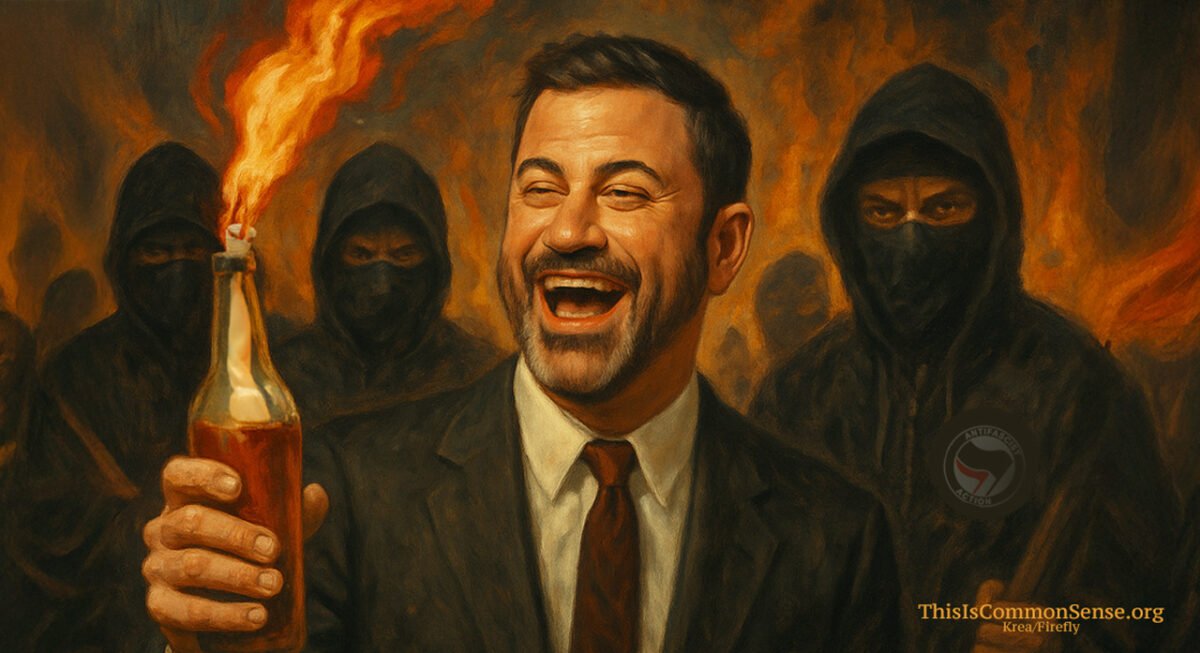
“Antifa does not exist”; “it’s just a made-up organization”; “Antifa is just an idea.”
That is the official position of the center-left governing classes. But the unofficial position is that Antifa should exist.
A more realistic view is that it exists in a decentralized (or distributed) manner, existing as an organizational tradition because what it indisputably is, in fact, should be clear to anyone: a blueprint for activists to commit crimes in public while avoiding prosecution.
Paul Jacob discussed the ontic status of Antifa in 2025.
Jonathan Turley covers the reality of Antifa in an October 22nd piece on his website. Antifa obviously exists where adherents to its goals, branding and methods enact it, as if channeling a demon: “Before Kyle Benjamin Douglas Calvert, 26, implanted an IED device outside of Alabama Attorney General Steve Marshall’s office in downtown Montgomery, he put up stickers reading ‘support your local Antifa.’
Numerous Antifa members have been arrested, including some who claimed to be journalists.
Many protesters belong to Antifa groups that have names like “Rose City Antifa” and offshoots like Love and Rage and Mexico’s Amor Y Rabia. Antifa members have been elected to the French and European parliaments.
Rutgers Professor Mark Bray’s “Antifa: The Anti-Fascist Handbook,” called by some the “Antifa bible,” explains that the group is united in its opposition to free speech. “Most Americans in Antifa have been anarchists or antiauthoritarian communists,” he writes. “From that standpoint, ‘free speech’ as such is merely a bourgeois fantasy unworthy of consideration.”
Free speech is of course quite palpable and real, where it exists; it remains coherent as a concept, when it doesn’t.
And it is bourgeois, in a sense. Remember that philosopher Tibor Machan wrote a book called Marxism: A Bourgeois Critique (1988)? And, before him, Frank Parkin wrote Marxism and Class Theory: A Bourgeois Critique (1979). Originating from within the bourgeoisie doesn’t make a theory, or institution, wrong, or even, reductively, “just in service to the entrepreneurial and management classes.” After all, the origin of a thing does not determine its value — neither truth-value nor utility.
Even those who accept a postmodern “power theory” epistemic should understand: were it the case that all ideological ideas are “nothing more than mere power grabs” — as students are taught in taxpayer-funded colleges — it remains the case that we who must take sides somewhat outside the fray can do so against masked criminals and for open dialogue.
This is not merely “theoretical.” Note a sort of boots-on-the-ground reality to the discussion . . . in Europe.
“Violent unrest across France has prompted a new intelligence assessment that reportedly identifies Antifa and other far-left extremist organizations as key instigators of the riots,” reports Geoff Harris at ABCNews4.com.
Over the weekend, massive demonstrations involving roughly 550,000 people turned violent. Rioters set fire to a 19th-century city hall and a tourism office in Lyon, while also looting shops in Paris. The violence led to more than 2,400 arrests. France’s Interior Ministry reported that roughly 1,000 police officers and hundreds of demonstrators have been injured. A demonstrator in Paris suffered a fatal cardiac arrest.
The State Department is also now warning that antifascist groups are planning to participate in a potentially more confrontational protest this weekend, as the far-right National Rally prepares to hold its political convention.
There will be plenty of time between conflagrations to argue the ontology of Antifa. Unless the “antifascists” go all the way and set the whole world aflame.